U.S Army Waist-to-Height Ratio Calculator
Summary
Waist-to-Height Ratio
Current vs. Army Standard Comparison
| Metric | Current | Army Standard |
|---|
Disclaimer: Results are estimates based on the current Army Waist-to-Height Ratio standard. They are intended for educational and fitness purposes only and do not determine enlistment eligibility, promotion eligibility, or overall military fitness. Consult official Army guidance or your chain of command for official assessments.
Accurate height and waist measurements are essential for a reliable result. Use a flexible tape measure, keep it level, and follow official Army measuring procedures.
Introduction
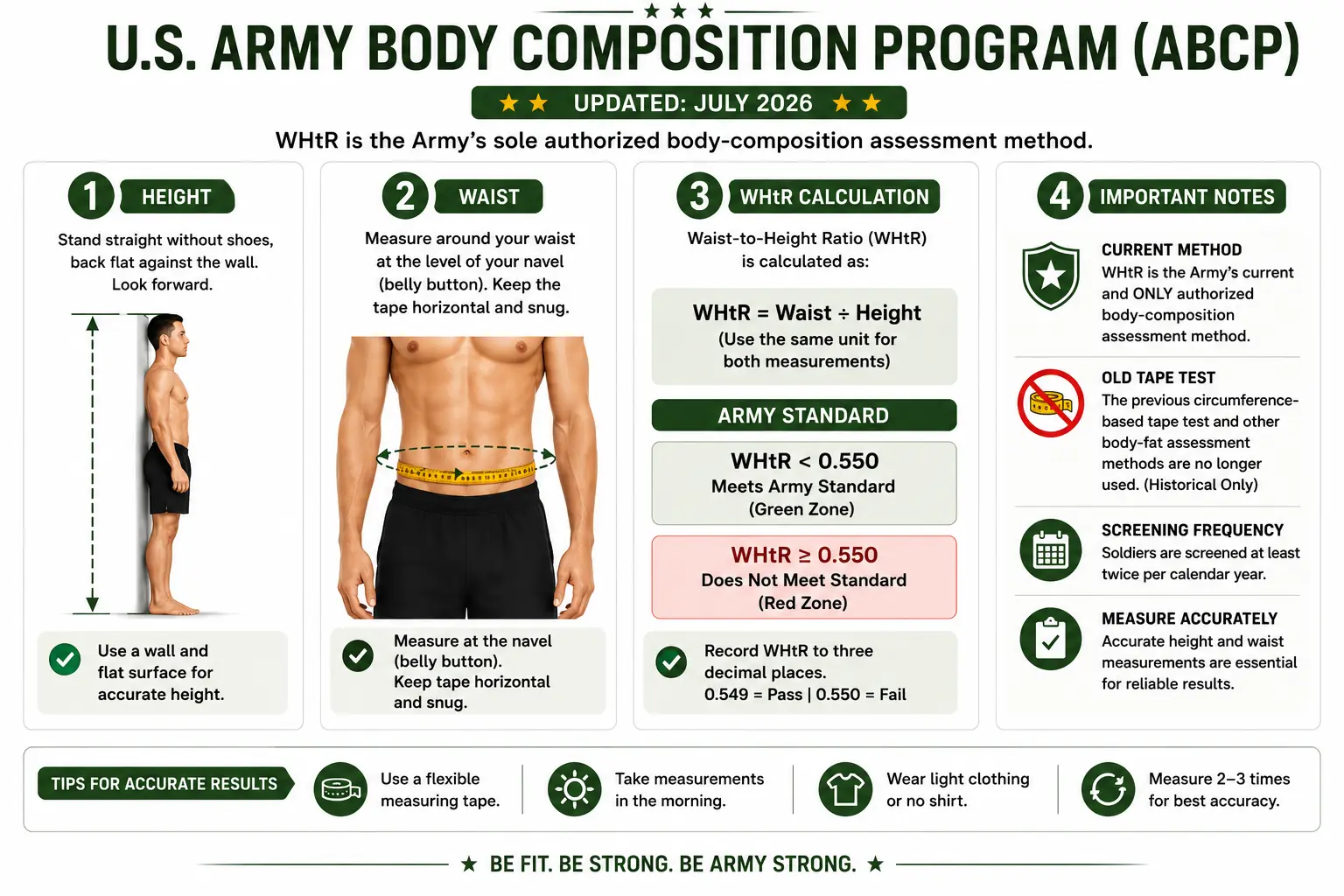
The U.S. Army Body Composition Program (ABCP) has changed how the Army checks body composition. In July 2026, the Army replaced the old height-and-weight tables and tape-test methods with the Waist-to-Height Ratio (WHtR). WHtR is now the Army’s official method for checking body composition. The calculation is simple: measure your waist circumference at the navel or belly button, measure your height, and divide your waist measurement by your height using the same unit. For the Army assessment, both measurements are recorded in inches.
Our calculator makes this process easier by calculating your WHtR and comparing it with the current Army standard.
What Is the Army Waist-to-Height Ratio?
Waist-to-Height Ratio (WHtR) is a simple measurement that compares your waist circumference with your height. Unlike BMI, which uses only height and weight, WHtR focuses on waist size relative to body height.
The formula is:
WHtR = Waist Circumference ÷ Height
For example, if your waist measures 34 inches and your height is 68 inches:
WHtR = 34 ÷ 68 = 0.500
A lower ratio means your waist circumference is smaller relative to your height. The Army adopted WHtR as its current body-composition screening method because it provides a simple and standardized way to assess body composition across the force.
U.S Army Body Compoistion Standard
The current Army standard is:
WHtR < 0.550 = Meets the standard
WHtR ≥ 0.550 = Does not meet the standard
The Army records WHtR to three decimal places. The value is not rounded; digits after the third decimal place are disregarded. This means:
| WHtR | Army Result |
| 0.549 | Meets standard |
| 0.5499 | Recorded as 0.549 and meets standard |
| 0.550 | Does not meet standard |
| 0.551 | Does not meet standard |
| 0.600 | Does not meet standard |
Old Army Tape Test vs New Waist-to-Height Ratio
The conventional Army tape test estimates body fat using measurements such as neck, waist, and hips for women. The technique uses a tape measure and an equation to calculate body fat percentage. For many years, this has been one of the most common methods used by the military to assess body composition and fitness standards.
Recently, new approaches, such as the waist-to-height ratio, have been highlighted as simple and sometimes more accurate. It compares waist size with height to estimate health and fitness risks. A lower waist-to-height ratio is associated with better body composition and lower health risks. Many experts believe that this method can provide a more accurate representation of your overall fitness than BMI alone.
Army WHtR vs BMI
| Feature | Standard BMI | Army WHtR |
| Main measurements | Height + weight | Waist + height |
| Main use | General weight screening | Army body-composition assessment |
| Uses waist size | No | Yes |
| Current Army standard | No | Yes |
| Best For | General health check | Military fitness standards |
| Used By Army | Limited | Yes |
| Army threshold | ______ | WHtR < 0.550 |
Army Body Fat Calculator vs Current Army WHtR Calculator
You may still see the term “Army Body Fat Calculator” in search results and in older military fitness information. Historically, the Army used circumference-based methods that estimated body fat from measurements such as the waist and neck.
However, those previous body-fat assessment methods are no longer valid. The current Army program uses the Waist-to-Height Ratio as the authorized body composition assessment method.
For this reason, an older Army tape test or body-fat calculator should not be presented as the current official Army compliance method.
How To Reduce Body Fat for Army Fitness?
To lose body fat for Army fitness, you need to be consistent, practise healthy habits, and get regular physical activity. The aim is to lose weight while also gaining strength, stamina, and overall fitness. Tiny improvements daily can lead to staggering results over time.
Maintain a Calorie Deficit
A calorie deficit happens when you burn more calories than you eat. This can help your body tap into stored fat for energy. Try to cut down on junk food and sugary drinks and too much fast food. Go for balanced meals instead.
Do Regular Cardio Exercise
Exercises like walking, jogging, running, cycling, and skipping can help burn calories and improve endurance. Even 30–45 minutes of daily activity can support fat loss and better army fitness preparation.
Include Strength Training
Push-ups, squats, planks, and weight training help build muscle and improve body composition. More muscle can also help your body burn calories more efficiently.
Eat More Protein and Healthy Foods
Protein-rich foods such as eggs, chicken, fish, yogurt, beans, and lentils can help maintain muscle while losing fat. Eating fruits, vegetables, and whole foods also supports better health and energy levels.
Get Proper Sleep and Hydration
Good sleep and proper water intake are very important for fat loss and recovery. Lack of sleep can impact metabolism and lead to increased fatigue during training and workouts.
Stay Consistent
Body fat reduction takes time and patience. Regular exercise, healthy eating, and discipline are key to improving fitness and meeting Army body fat standards.