Navy Body Fat Calculator
Navy Body Fat Calculator
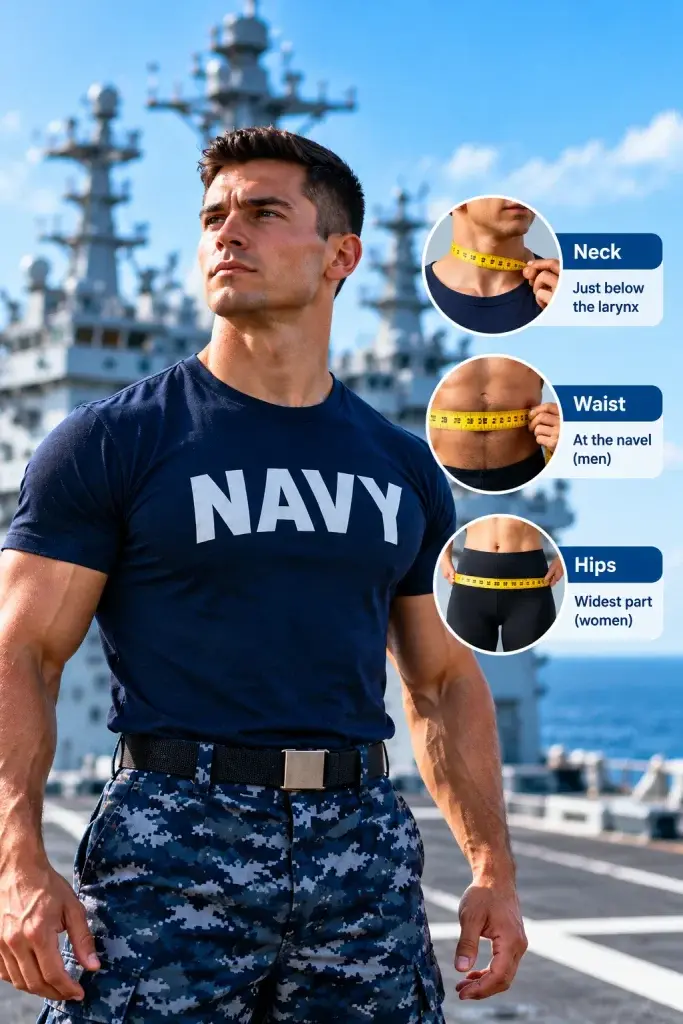
BMI can’t tell fat from muscle. This calculator uses the U.S. Navy method — height, neck, and waist (plus hips for women) — developed at the Naval Health Research Center, to estimate your actual body fat percentage.
Method (2026)
U.S. Navy formula
Needs
Height, neck, waist,Hips (women)
Neck
Just below the larynx
Waist
At the navel (men)
Hips
Widest part (women)
Calculate now
Navy BMI Calculator
Summary
Body Fat Level
Current vs. Age Reference
| Metric | Current | Age Reference |
|---|
Disclaimer: Results are estimates based on the U.S. Navy Body Fat Formula and BMI calculations. They are intended for educational purposes only and should not replace professional medical advice. Measurement accuracy directly affects the results.
Introduction
The Navy Body Fat Calculator estimates the percentage of your body weight that comes from fat using the U.S. Navy body fat method. It uses simple measurements such as height, waist, and neck, with hip circumference also used for women. This gives you an estimate of body fat and helps you understand your body composition beyond your scale weight.
Body weight alone does not show how much of your weight comes from fat versus lean mass such as muscle, bone, and organs. The Navy method can therefore provide additional information that a standard BMI Calculator cannot, making it useful for general fitness tracking and monitoring changes in body composition.
The result is an estimate rather than a direct measurement of body fat. Measurement technique and individual differences can affect the result, so use the calculator as a general reference rather than a medical diagnosis or official military assessment.
Body Fat Percentage Categories
| Category | Women (%) | Men (%) | What It Means | Typical interpretation |
| 🟢 Essential Fat | 10–13% | 2–5% | Minimum fat needed for basic body functions. Staying at this level can be unhealthy. | Very low, not a target |
| 🟢 Athletes | 14–20% | 6–13% | Lean and athletic, common in trained athletes | Lean, athletic |
| 🟡 Fitness | 21–24% | 14–17% | Fit, with a healthy-looking body | Fit |
| 🟡 Average | 25–31% | 18–24% | Typical range for the general population | Typical |
| 🔴 Obese | 32%+ | 25%+ | Body fat well above the typical range | Higher health risk |
Category ranges: American Council on Exercise (ACE). These are general fitness guides, not diagnoses or military body composition standards. Body fat percentage alone does not determine health. Values between listed ranges are placed in the nearest category. Speak to a doctor or dietitian if you are concerned about your result.
Ideal Body Fat Percentage By Age
| Age (Years) | Women (%) | Men (%) | What It Means | Health Level |
| 20 | 17.7% | 8.5% | Very lean, youthful body | Lean, young adult reference |
| 25 | 18.4% | 10.5% | Fit and active | Reference value rises slightly with age |
| 30 | 19.3% | 12.7% | Healthy and balanced | |
| 35 | 21.5% | 13.7% | Normal healthy range | |
| 40 | 22.2% | 15.3% | Slight increase with age | |
| 45 | 22.9% | 16.4% | Stable mid-age health | |
| 50 | 25.2% | 18.9% | Moderate fat increase | |
| 55 | 26.3% | 20.9% | Higher fat with aging | Reference value for older adults |
Reference values from the Jackson & Pollock research model, a general guide to how body fat tends to change with age. They are not health targets or a diagnosis. Your result can differ for many healthy reasons, including genetics, muscle mass and activity level. Speak to a doctor or dietitian if you have concerns.
What do you input?
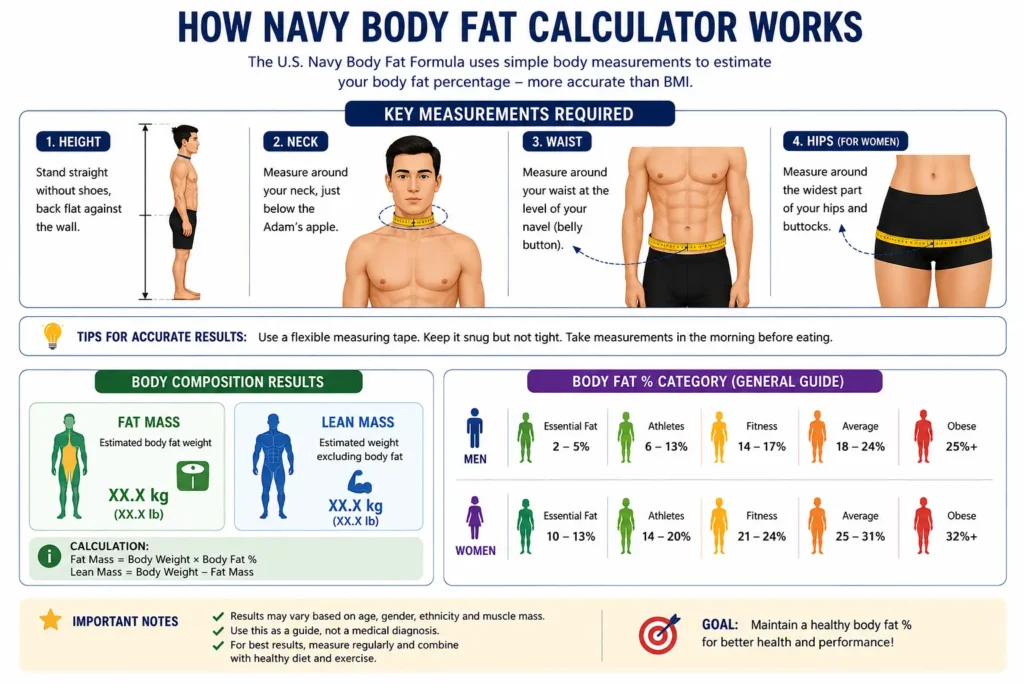
- Measure height — Stand straight without shoes
- Measure neck — Just below Adam’s apple
- Measure waist — Around the belly button
- Measure hips (women) — Widest part of hips
- Enter values — Imperial and metric units
What do you output?
- Body Fat: This is the percentage of your total body weight that comes from fat.
- Fat Mass: This is the part of your body weight that is made up of fat.
- Lean Mass: The rest of your body weight that isn’t fat, like muscle, bone, and organs.
- Body Fat Category: This shows your fitness level based on your gender and body fat percentage.
What To Do After Getting Your Body Fat Result?
After using the Navy Body Fat calculation, the most crucial step is determining the next course of action. Your result is not just a number—it is a guide to improve your health. Based on your body fat percentage, your result is a starting point, not a verdict. Use the table below as general guidance, and check with a healthcare professional before making changes.
| Body Fat Level | What It Means | What You Can Do |
| 🔴 High (Obese) | Too much body fat | Double-check your measurements. If the result is accurate, speak to a doctor before making any changes. |
| 🟡 Average | Normal but can improve | Keep up a balanced diet and enough recovery. Strength training helps maintain muscle. |
| 🟢 Fitness Level | Healthy and fit | Maintain your current routine if you feel well. |
| 🟢 Athletic | Very fit body | No change is needed unless you have a goal. Regular activity and balanced meals support long-term health. |
| ⚠️ Very Low | Too little fat | Talk to a doctor or dietitian about a safe plan. Regular activity and balanced meals are a good start. |
These are general suggestions, not medical advice. A tape-measure estimate can differ from the true value by several percentage points, so repeat your measurements before acting on one result. Speak to a doctor or dietitian before changing your diet or exercise routine, especially if your result is very low or high.
Navy Body Fat Formula
The U.S. Navy Body Fat Formula uses body measurements to estimate your body fat percentage.
| Category | Formula | Notes |
| Men (Inches) | BFP = 86.01 × log₁₀(Waist − Neck) − 70.04 × log₁₀(Height) + 36.76 | Waist, neck and height in inche |
| Women (Inches) | BFP = 163.21 × log₁₀(Waist + Hips − Neck) − 97.68 × log₁₀(Height) − 78.39 | Waist, hips, neck and height in inches |
| Men (centimeters) | BFP = 495 ÷ [1.0324 − 0.19077 × log₁₀(Waist − Neck) + 0.15456 × log₁₀(Height)] − 450 | Waist, neck and height in cm |
| Women (centimeters) | BFP = 495 ÷ [1.29579 − 0.35004 × log₁₀(Waist + Hips − Neck) + 0.22100 × log₁₀(Height)] − 450 | Waist, hips, neck and height in cm. The hip term is why the women’s formula differs |
The equation was developed at the Naval Health Research Center (NHRC) in San Diego, California.
Note:
- Results are estimated values, not exact.
- For high accuracy, methods like DEXA scans are used.
Navy Method vs BMI: Which is Better?
Understanding the difference between the BMI and the U.S. Navy Body Fat method is crucial for obtaining accurate health results.
BMI is a simple method that uses only height and weight to classify a person as underweight, normal, or overweight. It is quick and easy, but it cannot distinguish between fat and muscle. For example, a muscular person may have a high BMI but actually be very fit.
On the other hand, the Navy method uses body measurements such as waist, neck, height, and hips (for women). This helps estimate your actual body fat percentage, providing a clear and more realistic picture of your fitness level.
Navy Method vs BMI
| Feature | BMI | Navy Method |
| Uses | Height + Weight | Body measurements |
| Measures | Total body weight | Body fat percentage |
| Accuracy | Basic / Low | More accurate |
| Best For | General screening | Fitness & fat analysis |
| Muscle vs Fat | Cannot differentiate | Can estimate better |